
EU IN COLLABORATION WITH NAPTIP, IDEA ,ORGANISE A 2-DAY SEMINAR FOR JOURNALISTS IN OYO STATE, AIMED AT COMBATING SGBV IN NIGERIA.

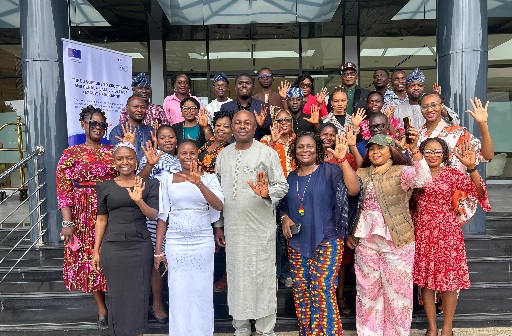
A 2-day seminar has been organised for selected journalists in Oyo State by the European Union (EU) in collaboration with the National Agency for the prohibition of Trafficking in persons ( NAPTIP) and the international institute for Democracy and Electoral Assistance (IDEA) aimed at combating sexual and Gender- Based Violence in Nigeria.
The overall objective of the two day programme is to strengthen public engagement on SGBV in Oyo State and other States such as Benue, Kaduna and FCT by improving the quality, ethics, and coordination of media and community-based communication.
The training aims to shift SGBV reporting and public discourse from sensationalism fragmented coverage to a more professional, survivor-centered, evidence-based, and action-oriented approach that promotes prevention, expands access to trusted information, strengthens referral pathways, and supports positive social norm change.
It also aims at enhancing community-level information-sharing structures relevant to SGBV prevention and response, including opportunities related to technology-facilitated gender-based violence (TF-SGBV) in Oyo , Benue, Kaduna and FCT
Earlier, while declaring the event open, the Director General of NAPTIP Bimta Lami Adamu Bello said the seminar was organised because journalists remained a critical partner in the fight against sexual and gender based violence in Nigeria
She commended media practitioners in the state for their cooperation, especially the publication of NAPTIP activities in the state .
Ms. Bello noted that her agency can not fight SGBV alone without the cooperation of journalists, law enforcement agencies, health and social services, and educational institutions .
The DG of NAPTIP noted that the situation of things in oyo State as regards to SGBV is serious and should be a concern to everyone, especially when sexual violence is involved.
The DG of NAPTIP represented by the Director of Media and Publicity, Mr Vincent Adekoye said that NAPTIP has continued to implement the provision of the Violence Against persons ( Prohibition) Acts 2015, resulting in increased prosecution and conviction of offenders.
The DG, however, frowns at non-consensual sharing of intimate images sextortion, cyberstalking, grooming of minors, deepfakes used for humiliation, and black mail and coordinated online harassment as emerging forms of technology induced gender-based violence. According to her, such abuses could be instantaneous, far-reaching, and capable of remaining online long after the initial incident.
Ms Bello while expressing NAPTIP appreciation to the European Union for the funding of the media component of the ESGBV programme and to international IDEA for implementing the project, said the initiative would culminate in the establishment and inauguration of a dedicated SGBV Media Corps across the four areas such as FCT, Oyo, Benue as well as Kaduna States.
The media lead facilitator and resource person and training workshops, Mrs Toyin Adewale, enumerated significant gaps in access to justice and support services, saying it has remained low as 41.8 per cent.
Implementation of the VAPP framework was described as partial, with gaps in enforcement and annual reporting , while weak public visibility of convictions put at 38.2
Although 79 per cent of respondents reportedly preferred formal justice system awareness of legal aid, it remained low at 35.4 per cent, while weak witness protection mechanisms continued to discourage reporting
She revealed that Oyo State had only one Sexual Assault Referral Centre (SARC), the Abiyamo Centre in Ibadan, thereby limiting access to specialised support for survivors, particularly those in rural communities. Awareness of the SARC stood at only 25 per cent, while awareness of available support services was 30.3 per cent. Staffing and funding for the centre were also identified as inadequate.
Disability-inclusive communication was described as weak, with only 17 per cent of respondents aware of Braille materials. Poor coordination between government ministries and civil society organisations was also said to have resulted in fragmented awareness campaigns.
Mrs Adewale recalled the horrific experience of a 2022 raped survivor in Ibadan, Ifeoluwa Apampa, and lamented that the incident was grossly underreported by the journalists in the state .
Journalists were later divided into two groups for a group presentation.